Showing posts with label MAZDA. Show all posts

Wednesday, June 9, 2010

Mercedes Benz E-Class Review

Mercedes Benz E-Class

Mercedes Benz E-Class Review


When the new Mercedes Benz E-Class arrived in showrooms in mid June of last year (2009), it was regarded in some circles as Mercedes Benz returning to its roots.

Well not quite back to the very beginning but the new car certainly has a hint of nostalgia for things past. This is especially noticeable on the dashboard where the almost regimented lines could look old fashioned, if it wasn’t for the modern switchgear and crisp digital graphics.
But where are its roots? Well, the new Mercedes Benz E-Class has been inspired by the Ponton. This was a car built in 1953 and one that lays claim to being the first car to be ‘spy photographed’, while it was being tested a year earlier.
A pinch of Ponton can be seen in the muscular rear haunches and strong design lines that define the rear wheelarches and sharply emphasise the shoulder line of the new car. It also has the effect of making the car look longer than its 4,568mm. Parking sensors are a standard feature, which is probably just as well as the length of the bonnet is deceiving, and the car overhangs standard parking spaces.
The front end features vary according to the trim level; the Avantgarde has a unique front bumper and a larger lower grille than the SE. It also has LED daytime running lights while the Sport has similar styling to the mighty AMG version, complete with side skirts and front and rear aprons.
What they all have in common are the twin headlight clusters, which became a distinguishing feature in 1995 and have developed over the years, to the sparkling geometric shape we have today. Generally, where the previous model majored on curvaceous styling with oval headlamps, the new Mercedes Benz E-Class is a much sharper and more angular interpretation of the long-serving and popular range.
The Mercedes Benz E-Class heritage can be traced back to 1947 and the Model 170 and since that time, we are told that Mercedes Benz has produced over 10million saloons in the series. The company also says that these numbers make it the world’s most successful business saloon.
Prices start at £25,570 OTR, which is not a million miles away from the top end Ford Mondeos and easily on a par with the Jaguar XF, which I imagine is its main competitor. That price is for the Mercedes Benz E200SE with 6-speed manual gearbox and, excluding the AMG version at £71,355, the most expensive Mercedes Benz E-Class is the E500 Sport with 7G-Tronic automatic transmission, at £48,610.

Mazda CX-7 Review

 Mazda CX-7

Mazda CX-7 Review


Towards the end of 2009, Mazda launched the new version of its capable crossover, the Mazda CX-7. Actually, according to the company, that should be Sports Crossover, or so it says in the information pack.


The Mazda CX-7 is a single model with no trim levels or engine choices to confuse the issue. And, it is of no consequence that there are no options, because what we have is plenty. From that you will gather that the Mazda CX-7 is a well specified car with a fuel efficient, turbo-charged, diesel engine and that anything else would be superfluous.
First impressions are that the latest version of the Mazda CX-7 is much the same as the previous model; such is the nature of make-overs. However, this new car is distinctly angular in some respects and deceptively slippery in other. So what we have is the same but different, however, the differences are enough to make the difference.
It does seem that the new Mazda CX-7 stands a little taller than the old one, or it could be simply an impression caused by the bold new housings for the outer air intakes and front lights, which are deep with a stylish chrome surround. Likewise, the new front grille has a similar trim around the black mesh and also sports a wider grin. The narrow, upper grille with its large emblem appears unchanged as do the headlight clusters.
The side view retains a certain familiarity but this aspect does serve to show off the length of the Mazda CX-7 and the darkened rear windows with their curved baseline, above the rear flanks. Smart crease-lines at the base of the doors add some character, as if the bulging wheelarches aren't enough.
At the rear end, the new car is slightly different in that the bumper, like that at the front, has undergone some re-profiling and there is now a chromed strip above the number plate recess. Looking back at images from the original Mazda CX-7 in 2008, it would seem that we have also lost a tailpipe.
I liked the Mazda CX-7's dark blue body colour, known as Stormy Blue Mica. It is one of five colour options, which include Brilliant Black and Aluminium Silver metallic finishes and a rather striking Copper Red.
So, with only minimal changes, the new Mazda CX-7 looks more up to date, while the taut shut-lines are an indication that the build quality hasn't been compromised in any way.

Monday, June 7, 2010

Volvo V50

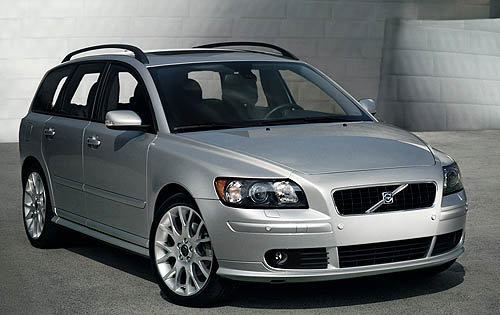
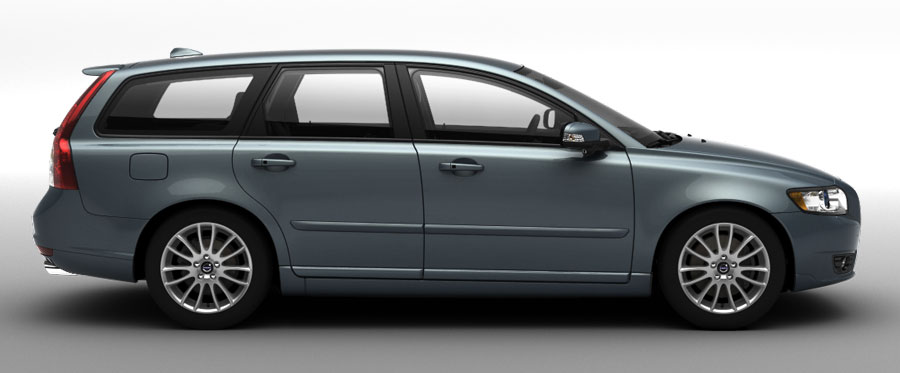
In Volvo nomenclature, "V" stands for "versatile." Versatility is great, but as the departed V40 wagon proved, it says nothing about excitement -- not when the other elements in the mix are drab sheet metal and mediocre performance. The Volvo V50 was conceived to replace this less-than-memorable small wagon, and it improves on the formula by offering more style and the opportunity for greater performance.

The compact V50 has been dubbed a "sport wagon" by Volvo. With its bulging fenders and grooved hood, this Volvo looks, dare we say, ripped. And it lives up to the "sport" part through its sharp handling and sprightly acceleration -- as long as you opt for the turbocharged engine, that is. With that turbo under its hood, the Volvo V50 feels nimble and brisk. Alas, the V50's normally aspirated base engine is far less impressive.

Still, with either power plant, this upscale small wagon is enjoyable on the inside, offering a design that's as ergonomically correct as it is distinctive. There are also plenty of safety features, with a lineup that includes side-impact and head curtain airbags, active head restraints and optional built-in booster seats for children. Combine all this with the utility offered by the available all-wheel drive, and Volvo's V50 distinguishes itself as providing plenty of "V" without being boring to drive or own.


Sunday, June 6, 2010

Volvo C70

The Volvo XC70 is an all-weather version of the V70 midsize wagon that boasts all-wheel drive as well as increased ground clearance and SUV-like styling cues. The latter two features are mostly for show, however, as the XC70 has never had much in the way of serious off-road hardware. What the XC70 has consistently offered is the sure-footedness of all-wheel drive, and it has become progressively more stylish and luxurious through the years, while maintaining its SUV-grade cargo space and superior reputation for safety.

The current generation Volvo XC70 is downright stylish all over, and it continues to offer many of the same virtues as previous versions: confidence-inspiring all-wheel drive, top-notch safety, a luxurious cockpit and enough cabin volume to satisfy all but the most haul-happy families. With the base inline six-cylinder engine, however, performance is lackluster -- other midsize wagons and a handful of crossover SUVs are both more satisfying to drive and comparably or more frugal at the pump. The turbocharged T6 model addresses the speed issue at least. The XC70 is a solid family vehicle, especially for those living in colder climates. Still, there are competing models that have similarly appealing traits, as well as superior power and/or efficiency.


Under the hood of the base model is a 3.2-liter inline-6 that sends 235 horsepower and 236 pound-feet of torque to all four wheels via a six-speed automatic transmission. Those numbers may look good on paper, but the XC70's actual acceleration performance and fuel economy are decidedly unimpressive. The T6 shares the six-speed transmission and AWD system, but adds a turbocharged 3.0-liter inline-6 that pumps out a more satisfying 281 hp and 295 lb-ft of torque.

The stylish XC70 should please any family that requires all-weather capability, carlike handling and an upscale cabin with plenty of cargo space. With the proliferation of crossover SUV offerings in recent years, however, there are numerous competing models that boast similar strengths along with better overall performance, particularly compared to the base 3.2-liter engine. We'd recommend taking a good look at what the market has to offer before you ante up for the current XC70, though those who ultimately go with the Volvo likely won't be disappointed.

Current Volvo XC70

The Volvo XC70 technically competes in the midsize wagon segment, although its standard all-wheel drive and SUV-like features make it competitive with crossover SUVs as well. Compared to a regular V70 wagon, the XC70 stands out, thanks to increased ground clearance (2.7 inches higher than the V70) and more rugged styling details that include cladding on the lower body sides and different front and rear fascias.

Offered in base 3.2 or uplevel T6 trim, the XC70 comes standard with plenty of convenience and upscale features, including alloy wheels, skid plates, roof rails, dual-zone automatic climate control, Bluetooth connectivity and an eight-speaker audio system. The T6 adds bigger wheels, dual exhaust outlets and a "watch dial" instrument cluster. Major options include leather upholstery, a navigation system, a rear-seat entertainment system, satellite radio and adaptive bi-xenon headlights.


Used Volvo XC70 Models

The present XC70 debuted in 2008. The most notable change since then has been the arrival of the T6 model with its turbocharged 3.0-liter engine; for 2008, the XC70 was available only with the base 3.2-liter inline-6.

The XC70 debuted in 1998 as the "V70 Cross Country" (XC for short) an upgraded trim level for the V70 wagon. With its advanced safety features (including side airbags from its inception), capacious interior, all-wheel-drive utility and trendy SUV looks, this endearingly boxy people mover quickly became a strong seller. Powered by a turbocharged 2.4-liter five-cylinder engine, the first-generation V70 XC was rated at 190 hp and 199 lb-ft of torque -- adequate in its day, but not exactly scintillating. Many buyers probably weren't even aware that the V70 XC came standard with skid plates, one of the few examples of genuine off-road equipment on this "SUW."

In 2001, the second-generation V70 XC was introduced. Like its V70 sibling, the new V70 XC sported a sleeker shape and a new platform shared with the first-generation S80 sedan, as well as a striking interior layout largely borrowed from the S60 sedan. In 2002, Volvo changed business tactics, dropping the "V70" from the car's title and marketing it separately from the V70 line as the Volvo XC. In 2003, the "70" designation returned, giving us the first official Volvo XC70.


Second-generation cars could be equipped with a navigation system for the first time. The 2.4-liter engine was tweaked to produce 197 hp and 210 lb-ft of torque, yielding satisfactory if not thrilling performance. In 2003, the 2.4-liter mill was replaced by a 2.5-liter five-cylinder engine that pumped out 208 hp and a healthy 236 lb-ft of torque, which made the XC70 feel rather quick. Rear-seat room was improved over the rather cramped first-generation car, though we still weren't overly impressed, and a third-row seat was available in every model year except 2007. Other available features included adjustable rear seats, four-zone climate control and a DVD entertainment system with front headrest-mounted TV screens.

Well-optioned second-generation XC70s were pricey in their day, but depreciation has helped matters somewhat. Still, the European and premium status of Volvos frequently translates to an expensive repair bill, should you run into problems. Those looking for a used Volvo XC70 should consider a certified pre-owned car or one that still has the factory warranty. If you care about performance, 2003 and later XC70s are the logical choice, as they offer a useful 26 extra lb-ft of torque as well as 11 more hp. Otherwise, you won't be missing much if you go with the 2001 or 2002 model.


Source from: Car